Physical Address
304 North Cardinal St.
Dorchester Center, MA 02124
Physical Address
304 North Cardinal St.
Dorchester Center, MA 02124

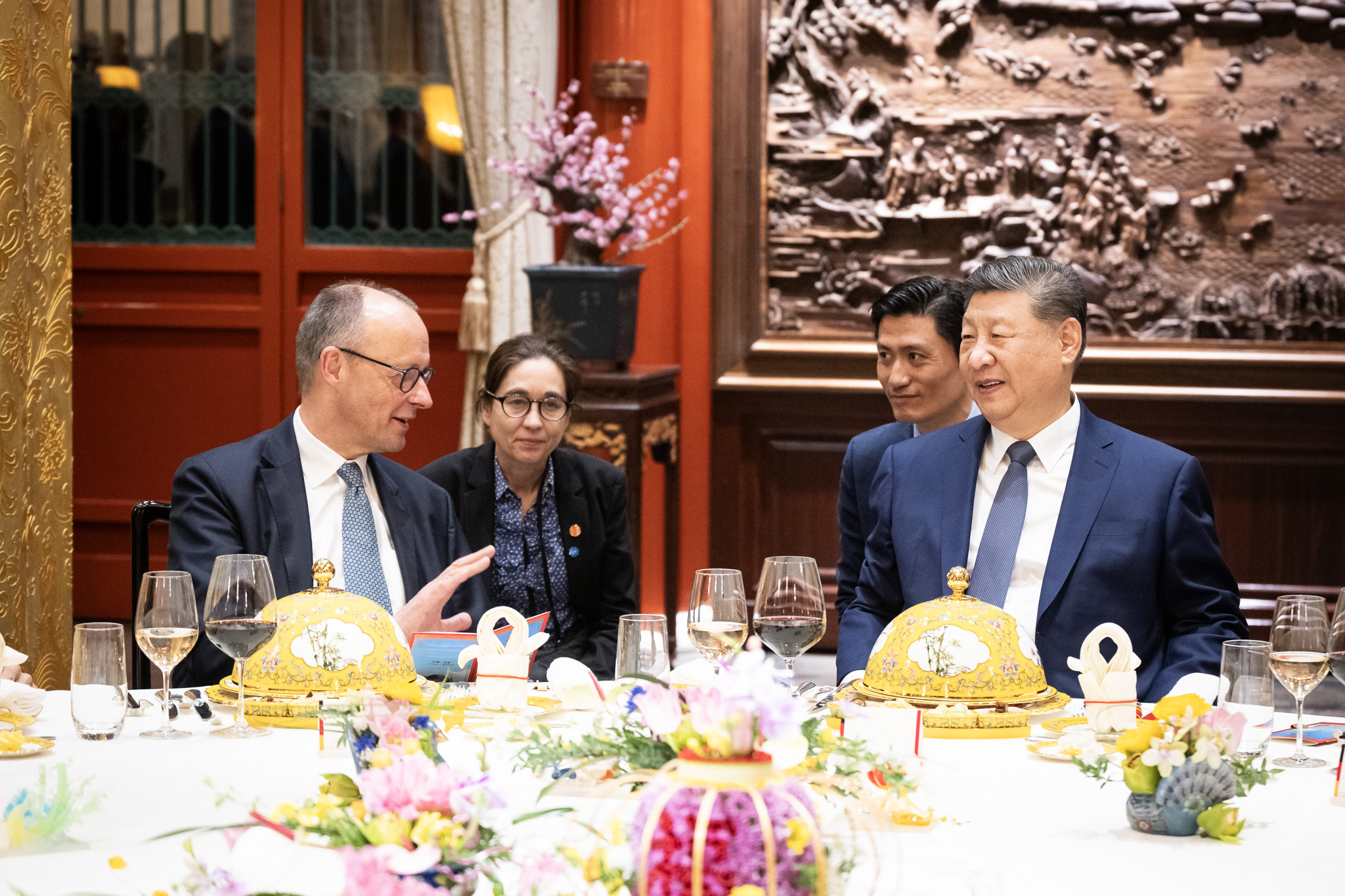
Photo: Federal Government/Guido Bergmann
The security-policy map is changing with remarkable speed. Just a few years ago, the transatlantic alliance was focused above all on Russia, the war in Ukraine, and the future of NATO. Today, another actor is increasingly coming into focus: China.
This is no longer purely about economic competition. In Washington, Berlin, Paris, and Brussels, there is a growing recognition that China’s economic rise is inseparably linked to military ambitions, technological sovereignty, and geopolitical influence. That is reshaping strategic planning on both sides of the Atlantic.
The United States has for years regarded China as its most important strategic competitor. Europe long struggled to embrace that assessment. Economic ties were too significant, and the hope that trade could defuse political tensions ran too deep. But that stance is now visibly changing. Germany and the European Union are hardening their course toward Beijing, particularly on questions of economic security, critical infrastructure, and technological dependencies.
This shift is especially visible in a term that barely played a role just a few years ago: economic security. Supply chains, semiconductors, rare earths, telecommunications networks, and artificial intelligence are no longer seen merely as economic factors, but as elements of national defense capability.
In recent days, the German government has further concretized its strategy on economic security. The goal is to make Germany and Europe more resilient against espionage, sabotage, and geopolitical pressure. This explicitly includes protecting critical infrastructure and reducing strategic dependencies.
Chancellor Friedrich Merz has emphasized in several public statements that Germany must expand its security-policy responsibility within Europe and that authoritarian states need to be strategically reassessed. His long-held position that China is increasingly also a security-policy challenge now shapes the foreign-policy debate in Berlin.

In the United States, too, the desire for a stronger European role is growing. In the US Congress, there is bipartisan agreement that Europe must build up its defense capability while at the same time cooperating more closely with the US in the Indo-Pacific.
Several Republican senators and members of Congress have reiterated in recent days that, while the transatlantic partnership remains indispensable, Europe must take on more responsibility for its own security. At the same time, they warn against underestimating China’s military modernization and call for reassessing economic dependencies through a security lens.
A notable strategic shift is emerging here. As the United States increasingly concentrates its military resources on the Indo-Pacific region, it expects European NATO partners to contribute more to deterrence on the European continent. This does not mean a turning away from the transatlantic alliance — rather, a new division of labor is taking shape.
From the perspective of Western military planners, China is pursuing a long-term strategy. The expansion of its navy, the modernization of its air force, and massive investments in hypersonic weapons, cyber capabilities, and space technologies show that Beijing is systematically expanding its military capabilities.
Add to this the close integration of state industrial policy and technological development. Unlike in many Western democracies, economic and military objectives can be centrally coordinated. It is precisely this connection that is causing growing concern among European security strategists.
At the center of this is not only the question of a possible conflict over Taiwan. Equally relevant are Chinese investments in ports, digital infrastructure, energy supply, and raw material supply chains. From a Western perspective, this is creating a network of strategic leverage that extends far beyond classic military policy.
Just a few years ago, the prevailing view in many European capitals was that China was above all an important trading partner. That assessment has given way to a markedly more sober analysis.
The European Union now speaks more often of “de-risking” rather than decoupling. This does not mean ending economic relations, but rather reducing strategic dependencies in particularly sensitive areas such as semiconductors, telecommunications, energy, and defense technology. At the same time, Germany is hardening its position on Chinese investment in critical infrastructure and key technologies.
The strategic rapprochement between Europe and the United States is visible today less in spectacular summit declarations than in day-to-day military cooperation. NATO planning, joint exercises, intelligence cooperation, and arms projects are increasingly being viewed through a shared question: how can the West simultaneously deter Russia and prepare for a long-term systemic rivalry with China?
There is a growing recognition that these two challenges cannot be separated from one another. From the perspective of Western security planners, Moscow and Beijing are watching very closely how united the transatlantic alliance is in responding to crises. Weaknesses in Europe could therefore also have consequences for stability in the Indo-Pacific.
While NATO geographically remains a North Atlantic alliance, its security-policy horizon is expanding. Partners such as Japan, South Korea, Australia, and New Zealand regularly take part in summit meetings. The goal is not to expand the Alliance’s territory, but to achieve closer coordination on cyber defense, space security, supply chains, and new technologies.
After the NATO summit in Ankara, Chancellor Friedrich Merz emphasized that Europe must take on more responsibility for Euro-Atlantic security. At the same time, he stressed that greater European engagement should strengthen the transatlantic partnership, not replace it. His formula was: “We will make NATO more European, so that it can remain transatlantic.”

This statement captures the course many European governments are charting: more self-reliance, without taking the United States out of the security-policy equation.
Similar signals are also coming from Washington — though with a different emphasis. Representatives of the US administration have repeatedly made clear that Europe must build up its defense capability more quickly. The debate over defense spending is only part of the discussion. Just as important are ammunition production, air defense, logistics, and the ability to deploy large formations at short notice.
US Secretary of Defense Pete Hegseth had already stated ahead of the NATO summit that the United States would review its troop presence in Europe. At the same time, he called on European partners to take on more responsibility for their own security.
In Berlin, this development is now understood less as a rupture than as an adjustment. The underlying assumption is: the stronger Europe becomes militarily, the more credible deterrence against Russia remains — and the more room for maneuver the US gains in the Indo-Pacific.
European military planners are following the situation around Taiwan with particular attention. Officially, the European Union continues to adhere to the One-China policy. At the same time, concern is growing that a military escalation would have significant consequences for the global economy.
A large share of the world’s most advanced semiconductors is produced in Taiwan. A conflict would affect not only the electronics industry, but also automakers, defense companies, medical technology, and telecommunications.
For this reason, European governments increasingly regard stability in the Indo-Pacific as a security interest of their own — even though they are not seeking a military leadership role there.
Another focus of transatlantic cooperation lies in the field of technology. Artificial intelligence, quantum computing, satellite communications, and autonomous systems are fundamentally changing military planning.
China has been investing massively in these areas for years. At the same time, the US and Europe are working to deepen their technological cooperation — for instance in semiconductors, cyber defense, and critical raw materials. The security-policy logic behind this is clear: whoever controls key technological industries also strengthens their military capacity to act over the long term.
For Germany, this development represents a profound shift. Just a few years ago, the notion of security-policy restraint prevailed. Today, higher defense spending, the expansion of the Bundeswehr, and investment in Europe’s defense industry stand at the center of the political agenda.
This is not about turning away from diplomacy or economic cooperation with China. Rather, Berlin and Brussels are pursuing the approach of “de-risking”: strategic dependencies are to be reduced without fully severing economic relations.
Despite close cooperation, differences remain. For the United States, China is the central long-term challenge. Europe, by contrast, must manage two strategic tasks at once: the immediate threat posed by Russia’s war of aggression against Ukraine, and the long-term competition with China.
Precisely for this reason, the division of labor within NATO is gaining importance. Europe is strengthening its defense capability on its own continent, while the US can direct a larger share of its military resources toward the Indo-Pacific. Both sides are ultimately pursuing the same goal: deterrence through unity.
Security cooperation between Europe and the United States is undergoing a phase of fundamental realignment. China is not the only, but an increasingly important, reference point for strategic planning. Military strength, economic resilience, and technological sovereignty are increasingly being considered together.
For Europe, this means a historic shift in role: away from a predominantly economic view of China, toward a comprehensive security-policy analysis. For the US, despite all calls for greater self-reliance, Europe remains the most important ally in stabilizing the international order.
Whether this new security architecture proves durable in the long run will not depend on defense spending or weapons systems alone. What will be decisive is whether the democratic states succeed in permanently coordinating their economic interests, their technological capabilities, and their political values in a world increasingly shaped by geopolitical competition.


