Physical Address
304 North Cardinal St.
Dorchester Center, MA 02124
Physical Address
304 North Cardinal St.
Dorchester Center, MA 02124

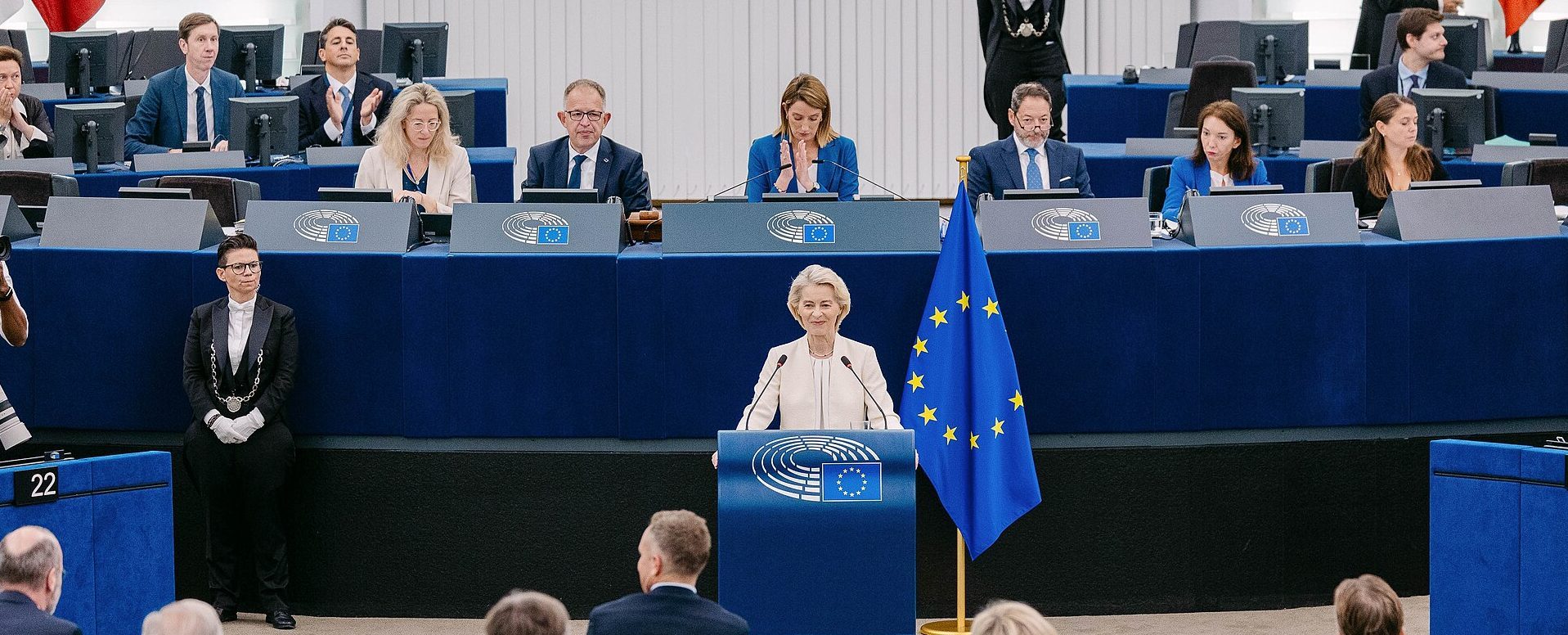
Ursula von der Leyen's 2026 "State of the Union" speech brought many new initiatives but no change of course. The EU sets too many goals and has too little strategy. The war in Ukraine, the new China shock and artificial intelligence show that Europe must finally become strategically capable. © European Union, 2026, CC BY 4.0, via Wikimedia Commons
Commission President Ursula von der Leyen’s “State of the Union” speech once again revealed the EU’s dilemma: there is a strategic gap between its many goals and their actual implementation. Once again, a series of new initiatives and programmes was announced. Yet in the past there have been too many of these rather than too few. On the contrary, they have led to economic overload and strategic weakening. Given the complex challenges, the EU must prioritise its goals more strategically. Otherwise, it will continue to lose effectiveness and speed in its effort to strengthen competitiveness and sovereignty.
Never, she said, had the European Union been stronger and at the same time more vulnerable. This is how Commission President Ursula von der Leyen described the state of the EU in today’s “State of the European Union” speech (“SOTEU”) in the European Parliament. In view of the pressing challenges, she announced a number of further initiatives and set out the EU’s normative positions. However, the EU’s two greatest weaknesses – the lack of an overarching narrative for the future and limited strategic clout – were barely addressed. The greatest symbolic impact came from the announcement that Canada would become the EU’s first “associate member”. It was made in the presence of Canadian Prime Minister Mark Carney, who had emphasised the role of middle powers in a world of great powers in a widely noted speech at the World Economic Forum in Davos earlier this year.
The overarching and recurring theme of von der Leyen’s speech was the various tipping points – from climate to artificial intelligence – and the resulting urgency to act, both to avert the major risks and to unlock the enormous potential. Europe, according to von der Leyen, must define its own “European way” and be able to make independent decisions.
However, von der Leyen’s speech left key questions unanswered. Recent years have shown that the EU has, if anything, become more vulnerable economically, technologically and in terms of security. A change of political course would therefore be called for. Yet no such change was discernible in her remarks.
Three challenges will determine whether Europe regains or continues to lose economic and political influence in the coming years: the war in Ukraine, the new China shock and the development of artificial intelligence.
At first glance, these three challenges seem to have little to do with one another. In fact, however, they point to the same problem: Europe lacks strategic clout. Formulating ever more goals will not change that. To achieve strategic goals, the EU must act more as a system – albeit an open one – in a global competition between systems. Ultimately, this requires it to gain weight in terms of power politics.
Russia’s war of aggression, for example, has long ceased to be merely a question of supporting Kyiv. It is a test of European sovereignty. Security can no longer be understood as a national supplement to the European project. It is one of its most important prerequisites.
Europe is experiencing a “China shock 2.0”. Unlike the first China shock, it is no longer about cheap consumer goods but about strategic industries such as mechanical engineering and the automotive industry. Europe should already be preparing for a “China shock 3.0”, when China combines its new industrial strength with AI and robotics and it is no longer just about individual sectors.
Europe must not be content with regulating AI or promoting individual European champions. What matters is the diffusion of AI across the breadth of industry. The crucial question is not whether Europe produces the next global language model, but whether its industry becomes more productive and innovative through AI.
Ukraine, China and AI thus lead to the same conclusion: Europe must become strategically capable. Only then can competitiveness and sovereignty be strengthened simultaneously amid geopolitical rivalry and technological upheaval. For a long time, the EU was above all a market, a legal area and a regulatory order. In the new world, it must also become a security area, a technology platform, an energy and data infrastructure, and an innovation system.
Strategic strength does not simply come from combating one’s weaknesses. The decisive question for Commission President Ursula von der Leyen is therefore not what Europe will regulate or promote next, but how Europe’s many strengths can give rise to a systemic capacity to act and to strategic power. To this end, the EU must reduce its enormous regulatory complexity and increase its low appetite for technological risk in order to seize the great opportunities and potential of the future.
Ultimately, in these times of great challenges, the EU can only function if it is economically strong. Only then will the EU move from promise to impact. Today’s “State of the Union” speech brought little that was new in this respect.


