Physical Address
304 North Cardinal St.
Dorchester Center, MA 02124
Physical Address
304 North Cardinal St.
Dorchester Center, MA 02124

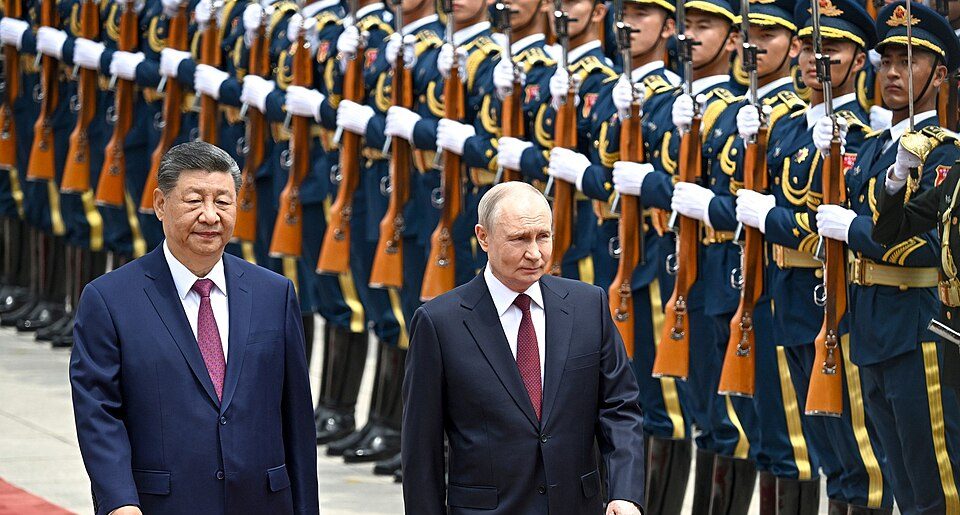
The United States is reviewing its troop presence in Europe while Russia puts Ukrainian air defenses under pressure with new drones. At the same time, Taiwan is waiting for American weapons. A strategic question is therefore growing in the US Senate: Can Washington deter Russia and China simultaneously – or must it choose between Europe and the Indo-Pacific? Xi Jinping and Putin © Kremlin.ru, CC BY 4.0, via Wikimedia Commons
WASHINGTON — More than 80,000 American military personnel and civilian employees currently belong to U.S. European Command. As recently as March, the US Department of Defense put the number of its personnel in Europe at more than 86,000. But the American presence on the continent is up for debate. The Pentagon has been reviewing its European force structure since June; according to Reuters, several options for possible changes are being drawn up. A significantly larger reduction of the American presence also remains under discussion.
Washington has thus arrived at a strategic debate that goes far beyond the number of American soldiers in Germany, Poland or Romania. Russia is stepping up its use of new drone types against Ukraine while simultaneously testing security on NATO’s eastern flank. In the Indo-Pacific, China is increasing military pressure on Taiwan, while Washington argues over billions of dollars in outstanding arms deliveries. At the same time, American air defense systems, precision munitions and industrial production capacity are not available in unlimited quantities.
The central question is therefore no longer only how much Europe must spend on its own defense. It is: How does a global military power distribute scarce forces and weapons between two strategic theaters when Russia and China both require deterrence at the same time?
This question is particularly well suited for an interview with members of the Senate Armed Services Committee or the Senate Foreign Relations Committee. That is because the debate there does not run neatly along party lines.
After Russia’s full-scale invasion of Ukraine in 2022, the United States temporarily increased its presence in Europe to around 105,000 troops. The number then declined again. In spring 2026, President Donald Trump also ordered the withdrawal of approximately 5,000 soldiers from Germany. American forces had already been reduced previously, including in Romania.
The question is where the lower limit of a credible American presence lies.
The Republican chairman of the Senate Armed Services Committee, Roger Wicker of Mississippi, is among the most outspoken critics of a rapid withdrawal. Following Russian incidents in NATO airspace, Wicker stated in August that the review of the American force posture must take into account that Europe’s higher defense spending cannot immediately be translated into operational military capabilities.
“It will take time to translate this spending into military capability,” Wicker said. The goal, he argued, must be a posture that ensures “credible deterrence of Russia and assurance of our allies.”
Wicker thus combines two positions that are frequently played off against each other in Washington: Europe should take on more responsibility – but the United States should not withdraw troops faster than the Europeans can close the resulting military gaps.
When Washington announced the withdrawal of a brigade from Germany in May, Wicker and the Republican chairman of the House Armed Services Committee, Mike Rogers, therefore proposed that the roughly 5,000 soldiers not be withdrawn from Europe but instead be relocated further east. A premature withdrawal could undermine “deterrence” and send Moscow the wrong signal, they said.
There is also resistance on the Democratic side. Jack Reed of Rhode Island, the ranking Democrat on the Armed Services Committee, called the withdrawal from Germany a serious mistake and warned against weakening the American presence while Russia attacks Ukraine and puts pressure on NATO states.
The conflict in the Senate is thus less about the demand for European burden-sharing than about its speed. NATO states have pledged higher defense spending. But in the short term, money alone produces neither Patriot interceptors nor artillery ammunition, air defense, logistics or combat-ready brigades.

At the same time, the war itself is changing.
Russia is now deploying jet-powered Shahed drones on a larger scale. They fly faster and higher than older propeller-driven variants and can therefore evade parts of Ukraine’s mobile air defenses. Reuters reported on September 22 that such drones reach altitudes of four to seven kilometers. Ukrainian mobile teams, which previously were able to engage many Shaheds with portable anti-aircraft weapons, sometimes can no longer reach them there. According to Reuters, Ukraine’s interception rate against these systems is now only around 60 percent, compared with roughly 90 percent previously against older variants. In the first three weeks of September alone, Russia reportedly launched around 2,100 of these attack drones as well as 136 missiles against Ukraine.
This also shifts the economic equation of air defense. When comparatively cheap drones force the use of expensive interceptor missiles, what matters is not only a system’s technical performance but also production volume and cost per kill.
NATO is already responding to this development. In September, the NATO Communications and Information Agency launched a competition for AI-supported systems designed to fuse data from various sensors and detect and classify small drones more quickly. The Alliance is also working with Ukrainian partners on new solutions against fiber-optic-guided FPV drones – systems that can bypass electronic countermeasures.
For Washington, Ukraine is therefore not only a European theater of war. It is a testing ground for technologies that would also be relevant in a possible conflict in the Indo-Pacific: autonomous systems, low-cost drones, electronic warfare, distributed sensors and precision weapons available in large numbers.
Democratic Senator Jeanne Shaheen, the ranking member of her party on the Foreign Relations Committee, explicitly described this problem in June. The war had shown “that the defense stockpile that we thought we had for weapons is not as good as we thought it was.” The industrial base had also been less responsive than assumed, she said. At the same time, drones, artificial intelligence and other technologies were transforming warfare at high speed.
In August, Shaheen went one step further. Citing statements by Ukrainian President Volodymyr Zelensky, she warned that China was helping Russia develop its own alternative to Starlink. Should this technology become available, it could further improve Russia’s drone capabilities.
The two theaters are thus already merging technologically: China is not only Washington’s most important military competitor in the Pacific. Chinese technology, components and economic ties to Russia are at the same time influencing the war in Europe.

The other side of the equation lies roughly 8,000 kilometers east of Ukraine.
Taiwan is trying to build up its armed forces for an asymmetric defense against the People’s Republic of China. The focus is on mobile missiles, air defense, drones, counter-drone systems, command and communications structures, and sufficiently large ammunition stockpiles.
But it is precisely with American weapons that there are considerable delays.
A planned US package for Taiwan worth up to 14 billion dollars had still not been fully implemented over the summer. Taiwan’s representative in Washington, Alexander Yui, told the Associated Press in June that the island needed the American weapons for its self-defense. Senators from both parties have been pressing the administration for months to speed up deliveries and approvals.
Shaheen had already warned in April that weapons worth billions were in the delivery pipeline to Taiwan. Any suggestion that arms sales could be delayed because of relations with Beijing, she argued, undermines Washington’s credibility – and not only in the Indo-Pacific.
Together with Republican Senators John Curtis and Thom Tillis and Democrat Jacky Rosen, she also called on Taiwan to increase its own defense investments. Among the items mentioned were American counter-drone systems, an integrated battle management system and medium-range munitions for air defense. The senators explicitly referred to lessons from recent wars: modern armed forces need relatively inexpensive, dynamically deployable systems in large numbers.
Curtis draws the connection between the theaters particularly clearly. After a visit to Ukraine, the Republican said China was closely watching how Washington responds to Russia’s war. “What happens in Ukraine is directly tied to Taiwan and stability in the Indo-Pacific,” Curtis said.
This thesis is contested in Washington. Critics of a strong American commitment in Europe argue that forces, munitions and political attention must be reserved for the Indo-Pacific. Supporters of a strong NATO presence, by contrast, argue that a withdrawal from Europe could also weaken American credibility vis-à-vis Beijing. The debate thus concerns not only resources, but two different ideas of how deterrence works.
Behind the geopolitical debate lies an industrial problem.
Patriot interceptors, long-range precision weapons, artillery ammunition and other systems cannot be distributed at will between Europe, the Middle East and the Indo-Pacific. The war in Ukraine has exposed the production limits of the Western defense industry. Conflicts in the Middle East have further increased demand.
This may be precisely where the most important link between Russia and China policy lies: Washington cannot answer the strategic question “Europe or Asia?” through troop movements alone. What is decisive is whether the United States and its allies can produce enough weapons to make deterrence credible in several regions at the same time.
Congress has responded. The 2026 defense budget strengthened investments in the industrial base, drone production and lower-cost weapons systems, among other things, and combined support for Ukraine with additional measures for the Indo-Pacific and Taiwan. Wicker spoke of a necessary restoration of the American “arsenal of democracy.” Democratic Senator Reed said the law strengthens America’s position against competitors while also strengthening alliances in Europe and the Indo-Pacific.
On Ukraine, too, a bipartisan group of senators is now relying more heavily on European financing and faster production. In July, Thom Tillis, Tim Kaine, John Cornyn, Chris Coons, Mark Kelly and other senators introduced a bill intended to facilitate the purchase and transfer of large quantities of comparatively simple munitions to Ukraine. These include 155-millimeter artillery ammunition as well as HIMARS and GMLRS munitions.
The model behind it could become relevant for American strategy as a whole: Europe takes on more financing and conventional defense capacity, while the United States increases its industrial production and keeps certain hard-to-replace capabilities available for multiple theaters.
The political pressure to set priorities nevertheless remains.
As recently as September 22, Shaheen, Reed, Chris Coons, Mark Warner, Elizabeth Warren and other Democratic senators warned of China’s military pressure on Taiwan while also pointing to Beijing’s support for Russia’s war economy. The link between the two challenges has thus long been part of the debate on Capitol Hill.
Republicans, too, are increasingly arguing across theaters. Wicker stated in March that American operations and support in Europe, the Middle East and other regions are connected to the strategic competition with China. At the same time, he criticized that Washington cannot ask allies to do more while reducing its own support more quickly.
That is exactly what makes the simple alternative “Europe or China?” such a productive interview question. Because every answer forces concrete decisions.
How many US soldiers does Europe need for Russia to remain deterred from attacking NATO territory? Which capabilities can European states take over – and by when? Should American Patriot systems and other scarce weapons be reserved primarily for Taiwan and the Indo-Pacific? Which lessons from Ukrainian drone warfare must be incorporated immediately into Taiwan’s defense planning? And how large must the American defense industry become so that Washington no longer has to choose between allies and theaters?
The Pentagon’s review of the European troop presence makes these questions urgent. According to Reuters, options are currently being developed for the future structure of the roughly 80,000 American forces in Europe. On September 17, Shaheen and seven other senators called on Secretary of State and National Security Advisor Marco Rubio to involve the State Department more closely in these decisions. Changes that might appear militarily limited could have significant consequences for relations with NATO partners, especially on the eastern flank, they argued.
A question about troops thus becomes a fundamental question of American strategy.
Washington still has a global alliance system that neither Russia nor China possesses in comparable form. At the same time, this network must be backed militarily: with soldiers, air defense, munitions, production capacity and political credibility.
The decisive question for senators is therefore not only whether Europe or China should receive priority.
It is which military capabilities Washington must keep in Europe, what responsibility the Europeans can take on, and what industrial capacity is needed so that the United States can deter Russia without weakening its position toward China and its support for Taiwan.
This is precisely where Washington’s three most important security policy debates of the moment converge: the future of US troops in Europe, the technological lessons from the drone war in Ukraine, and the question of whether American arms deliveries to Taiwan are arriving quickly enough to keep deterrence in the Taiwan Strait credible.


